
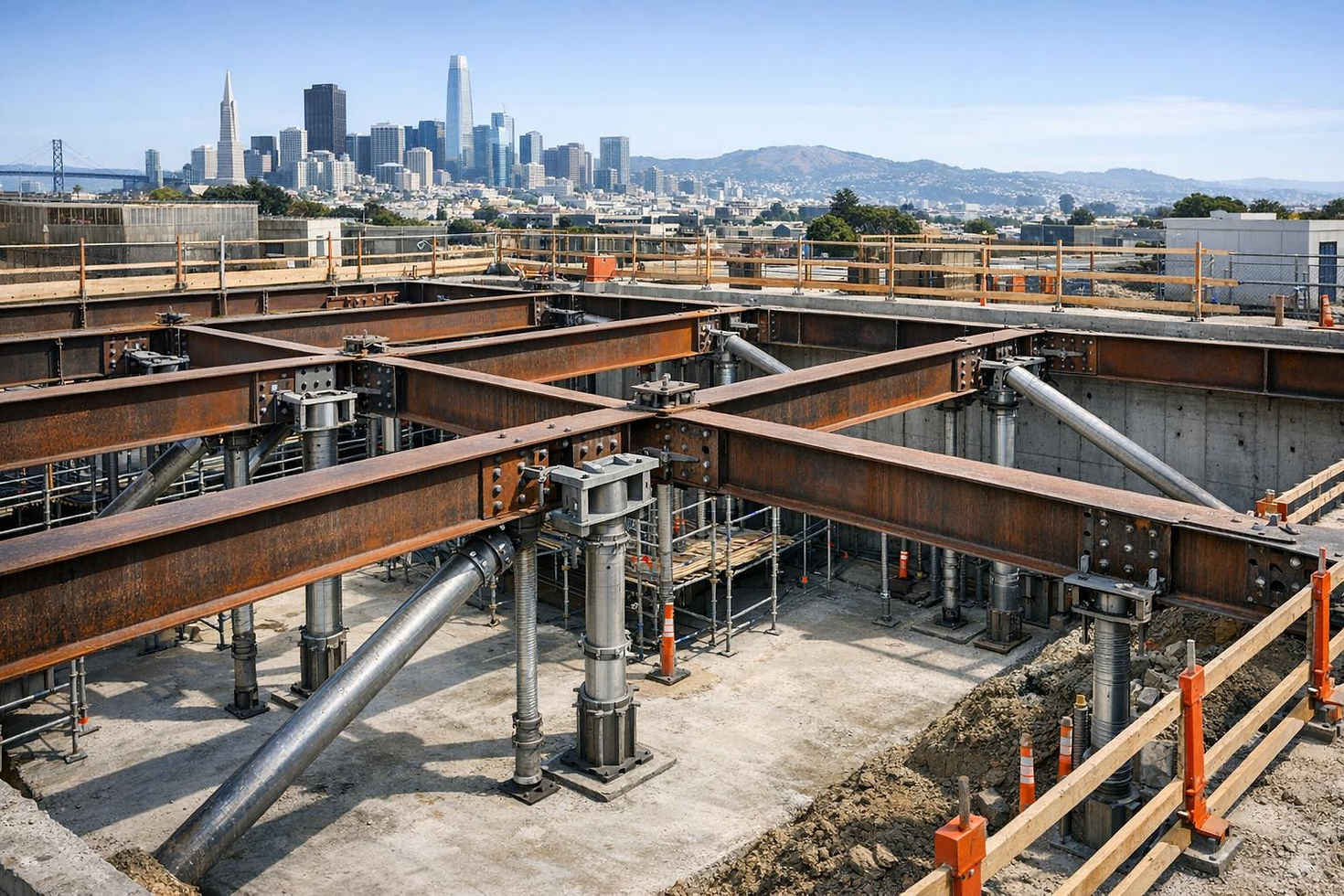
Bay Area Building Codes: Structural Shoring Requirements Explained
- Joe Lazzaretti
- Jan 2
- 10 min read

Updated: Jan 3
The Bay Area enforces some of the strictest shoring regulations in the U.S. to address seismic risks and ensure construction safety. With over 700 earthquakes annually, proper shoring is critical to prevent excavation collapses and protect workers and nearby structures. Here's what you need to know:
Key Requirements:
Shoring systems taller than 14 feet or spanning over 16 feet must be designed and certified by a licensed California civil engineer.
Systems must handle a lateral load of at least 100 pounds per linear foot or 2% of the total dead load, whichever is greater.
Excavation must halt if adjacent buildings shift by 0.5 inches or soldier piles move 1 inch.
Monitoring:
Weekly monitoring is required during excavation; bi-weekly after stabilization; monthly once the ground floor is complete.
Immediate action is needed if movement exceeds 0.75 inches for buildings or 1.5 inches for soldier piles.
City-Specific Rules:
San Francisco requires permits, 10-day advance notice to neighbors, and barriers for excavations near lot lines.
Temporary shoring (under 2 years) and permanent systems have distinct material and corrosion protection standards.
Popular Systems:
Soldier piles: Common for urban projects up to 40 feet deep, but require dewatering.
Secant piles: Ideal for watertight barriers in groundwater-heavy areas.
To comply, keep shoring layouts on-site, monitor regularly, and follow city-specific guidelines. These rules help prevent failures and keep projects safe in one of the most earthquake-prone regions in the U.S.
What Are The Different Excavation Shoring Systems? - Civil Engineering Explained
Bay Area Building Code Requirements for Structural Shoring
Shoring projects in the Bay Area operate under a layered set of regulations. At the foundation lies the California Building Code (CBC) Section 1812, which sets baseline construction standards. Worker safety is governed by Cal/OSHA Construction Safety Orders (Title 8), specifically Article 6 for excavation and Article 29 for vertical shoring and falsework [1]. Beyond these state-level mandates, individual cities tack on their own requirements, creating a localized layer of oversight.
Shoring systems must handle a combined live and dead load of at least 100 pounds per square foot (psf) and withstand lateral forces of at least 100 pounds per linear foot or 2% of the total dead load, whichever is higher [1]. If motorized carts are involved, the design load must increase by 25 psf [1].
For systems taller than 14 feet or spanning more than 16 feet horizontally, design calculations and drawings signed by a California-registered civil engineer are mandatory [1]. After construction but before pouring concrete, the same engineer must inspect and certify the system in writing to confirm compliance with approved plans [1]. Additionally, a copy of the shoring layout must always be available on-site for inspection [1].
Below, we’ll explore specific standards for San Francisco, state trenching guidelines, and how requirements vary across Bay Area cities.
San Francisco Building Code AB-111: Geotechnical and Shoring Standards
In San Francisco, excavation, fill, and grading projects must submit Form 5 to the Department of Building Inspection (DBI). As of January 1, 2024, DBI has fully transitioned to electronic plan reviews for in-house permits, including those for complex shoring and new construction.
Property owners must notify adjacent building owners in writing at least 10 days before excavation begins [5]. Excavations within 5 feet of a street lot line must be enclosed by a barrier at least 6 feet high [5]. Walkways at construction sites must be designed to support a live load of at least 150 psf [5].
For vertical shoring, an additional live load allowance of at least 20 psf must be included on top of the concrete's weight [1].
California State Trenching and Shoring Manual Guidelines
California distinguishes between temporary and permanent shoring based on how long the system is exposed. Systems in place for 2 years or less are classified as temporary, while anything exceeding that timeframe is considered permanent and must account for increased lateral soil pressure from seismic activity [2]. Permanent shoring systems cannot use wood components if they will be exposed for more than 2 years [2].
Anchors used in production must be tested at 150% of their design loads, while performance tests require 200% [2]. For tie-back anchors near buildings, load cells must be installed every 50 feet or less, with at least one cell per wall. Readings must be taken daily during excavation [2].
Corrosion protection depends on the system’s duration. Class I protection is required for all permanent anchors and temporary anchors used for more than 2 years, while Class II is acceptable for shorter durations [2]. Calibration data for test jacks and gauges must be independently verified within 120 days of submission [8].
How Shoring Requirements Differ Across Bay Area Cities
While the CBC and Title 8 provide a statewide framework, cities like San Francisco, Oakland, and San Jose often impose additional requirements tailored to their unique soil and seismic conditions [8]. For instance, San Francisco supplements the CBC with Administrative Bulletins, such as AB-082, to address the complexities of urban sites [7].
Monitoring practices are fairly consistent across the Bay Area. For example, soldier piles are typically monitored weekly during excavation until the subgrade elevation is reached [2]. Once excavation stabilizes, monitoring shifts to bi-weekly until the ground floor slab can handle lateral loads, and then to monthly after the ground floor is completed [8]. Monitoring results must be submitted to the shoring design engineer and building official within three working days [8].
Here’s a breakdown of monitoring phases and frequencies:
Monitoring Phase | Frequency of Readings |
Pre-Excavation | Initial monitoring before work begins |
During Excavation | Weekly until subgrade elevation is reached |
Post-Excavation (Standard) | Bi-weekly until ground floor slab stabilizes |
Post-Excavation (Stabilized) | Monthly after ground floor completion |
Tie-back Anchor Loads | Daily during excavation; weekly after |
Monitoring points must be set at the top and anchor heads of soldier piles, with control points placed outside the "area of influence" to ensure accuracy [8]. If building movement exceeds 0.75 inches or soldier pile movement surpasses 1.5 inches, additional shoring must be developed and approved before work can continue [8].
Shoring Systems Used in Bay Area Construction
Contractors in the Bay Area rely on various shoring systems to tackle the unique challenges posed by each construction site. The choice of system depends on several factors, including soil type, excavation depth, groundwater issues, proximity to nearby structures, project timelines, and the need for watertight barriers.
Soldier pile shoring, which uses H and I-beams, is a popular choice for urban excavations up to 40 feet deep. This method involves driving or vibrating steel beams into the ground and placing timber or pre-cast concrete lagging between them to hold back the soil. Since the lagging allows water to pass through, dewatering is required. To ensure safety, soldier piles are monitored weekly during excavation, with work stopping if movement exceeds 1 inch [3].
Secant pile shoring creates a continuous, interlocking wall by drilling overlapping concrete piles. This system is ideal for sites where controlling groundwater is critical, as the interlocking design forms a watertight barrier. It’s particularly effective in tight excavation spaces or near structures that need maximum water protection [9][10]. In contrast, contiguous pile shoring places piles close together without overlapping, leaving small gaps. While it effectively manages structural loads, it doesn’t block water, so additional dewatering measures are necessary [10].
Other methods, such as soil nail and raking systems, provide lateral support through different approaches. Soil nails involve prestressed anchors installed in soil or rock and are often used to stabilize slopes or hillsides. Raking systems, on the other hand, use internal bracing members that lean against the excavation wall. Both systems must adhere to strict tie-back anchor testing standards.
The intended duration of use also influences the choice of shoring system. Temporary shoring, exposed for two years or less, has different corrosion protection requirements compared to permanent installations. Permanent systems must avoid wood components and account for the additional lateral pressure caused by seismic activity [2][3].
Design and Engineering Requirements for Shoring
Soil Testing and Site Investigation
A thorough geotechnical report is essential for any shoring project. This report must include details like anchor tension, bond stress, earth pressure, and seismic increments [2][6]. It should also address interactions between soil and structural elements, such as piers, shafts, and piles, and provide lateral stiffness values required for precise design calculations.
To safeguard all parties involved, document existing structures within 100 feet - or three times the shoring depth - using written logs and photographs [2]. This step helps protect both contractors and neighboring property owners from potential disputes. Additionally, the geotechnical report should identify subsurface obstructions, such as boulders or cobbles, so contractors can plan appropriate drilling techniques for soldier piles and tie-back anchors [2][6].
Monitoring points must be established on pile tops and anchor heads, with weekly readings taken until the subgrade and permanent foundation are completed [2][6]. These site-specific details play a critical role in informing seismic design adjustments.
Seismic Design Requirements
Given the seismic activity in the Bay Area, shoring designs must meet rigorous standards. Accurate soil investigation is the foundation of effective seismic design. Permanent shoring systems, defined as those exposed to site conditions for more than two years, must account for increased lateral soil pressure caused by earthquakes [2][6]. Temporary systems (lasting less than two years) are exempt from this seismic pressure calculation but must still adhere to strict lateral load requirements.
Shoring systems must withstand lateral loads at each floor in both directions, calculated as no less than 100 pounds per lineal foot of floor edge or 2% of the total dead load, whichever is greater [1][4]. To avoid delays in obtaining permits, geotechnical reports for Bay Area projects must specifically include seismic increments of earth pressure loading [2].
Construction documents must clearly state the seismic design category and site class, as these determine the specific spectral response acceleration parameters used in engineering calculations [11]. For permanent anchors, a minimum safety factor of 2.0 must be applied at the ground-soil interface [2]. Additionally, all prestressed anchors undergoing performance testing must include a creep test to verify long-term stability [2][6].
Groundwater and Environmental Management
Managing groundwater is increasingly critical, especially with rising sea levels in the Bay Area. Projections indicate sea levels in San Mateo County could rise by up to 3.3 feet by 2070 and 6 feet by 2100 [13]. This rise in the water table poses a risk of remobilizing buried industrial pollutants, such as benzene, lead, and arsenic, which could create new pathways for contamination.
"Anytime you're leaving contamination in the ground, if those conditions change, such as the water table is rising, that provides the potential to remobilize contaminants and create a new exposure pathway that could impact the environment or public health." - Christine May, Founder, Pathways Climate Institute [12]
All shoring components must incorporate corrosion protection. Permanent anchors (over two years) require Class I protection, while temporary anchors need Class II [2]. For areas with high groundwater, tremie methods for concrete placement are recommended to maintain structural integrity without fully dewatering the shaft [2]. If tremie methods are not used, all water and loose materials must be removed from drilled holes before installing piles or tie-backs [2].
Grout pressure must be carefully managed during installation to prevent soil heave or rock fracturing, with a recommended post-grout pressure of 300 psi for all soil types [2]. After lagging installation, contractors should immediately backfill voids between the lagging and soil to prevent ground loss [2]. Load cells should also be placed at tie-back heads near buildings, spaced no more than 50 feet apart, to monitor stress changes during excavation [2].
Conclusion
Bay Area shoring requirements are in place to prevent dangerous failures that could endanger lives and damage property. Without proper shoring systems, excavation sites can face severe risks like wall collapses and structural instability. These guidelines form the foundation of safe and compliant construction practices in the region.
Shoring systems must handle a combined load of at least 100 pounds per square foot, while lateral bracing must withstand a minimum of 100 pounds per lineal foot or 2% of the total dead load, whichever is greater [1][4]. Excavation should stop immediately if nearby structures shift ½ inch or if soldier piles move 1 inch. If these movements increase to ¾ inch and 1.5 inches, respectively, additional shoring approved by officials becomes mandatory [2].
To stay compliant:
Keep your shoring layout on-site for inspection.
Ensure systems taller than 14 feet or spanning more than 16 feet are signed off by a California-registered civil engineer.
Set up monitoring points and take weekly readings once excavation begins.
Notify neighboring property owners at least 10 days before starting work [1][4][2][5].
Considering the Bay Area's seismic activity, high groundwater levels, and dense urban environment, proper shoring is not just a regulatory requirement - it’s a critical step in protecting lives and ensuring construction projects are completed safely. By adhering to these detailed codes and guidelines, you help secure both public safety and the success of your project.
FAQs
What’s the difference between temporary and permanent shoring systems under Bay Area building codes?
Temporary shoring serves as a short-term support system during construction, primarily used to hold back soil or support formwork. In the Bay Area, these systems are typically designed for a maximum of two years and must withstand short-term loads, including a minimum of 100 pounds per square foot for combined live and dead loads. Common options include timber props, steel frames, and soldier-pile systems. These supports are inspected daily to ensure safety and are removed once the construction project is completed.
In contrast, permanent shoring is a long-term solution that becomes a part of the finished structure. It must adhere to stricter durability and performance standards, as outlined in the 2022 California Building Code. Designed to handle long-term loads, settlement factors, and integration with the building’s foundation, permanent systems often feature tie-back anchors. These systems undergo thorough inspections to ensure they meet all code requirements and perform reliably over time.
How do seismic conditions in the Bay Area impact shoring design requirements?
The Bay Area's proximity to the San Andreas Fault makes earthquake safety a top priority in shoring design. California's seismic design standards require temporary shoring systems to handle the intense ground-motion forces caused by earthquakes. These regulations outline specific criteria like damping ratios, load combinations, and bracing configurations to ensure structures remain secure during seismic events.
State laws also demand that shoring systems resist both vertical and lateral forces. For lateral loads, the minimum starts at 100 lb/ft along floor edges, but in seismic zones, these requirements increase significantly to account for the added stress from earthquakes. On top of this, the San Francisco Building Code introduces stricter local amendments to the California Building Code, adding an extra layer of protection for projects within the city and nearby areas.
By following these rigorous standards, designers can develop shoring systems that safeguard workers and structures against the Bay Area's frequent seismic risks.
What should I do if excavation movement exceeds the allowed limits?
If excavation movement exceeds acceptable limits, it’s a serious safety issue that demands immediate attention. Work in the affected area must stop immediately, and the shoring design engineer should be contacted without delay to evaluate the situation. A qualified professional will then assess the site, measure the extent of the movement, identify the cause, and suggest appropriate corrective measures.
To secure the excavation, solutions like adding extra shoring, benching, or other temporary supports may be necessary. Any changes to the shoring design must receive approval from the engineer before work continues. These precautions ensure adherence to Bay Area building codes while prioritizing a safe working environment.


Comments