
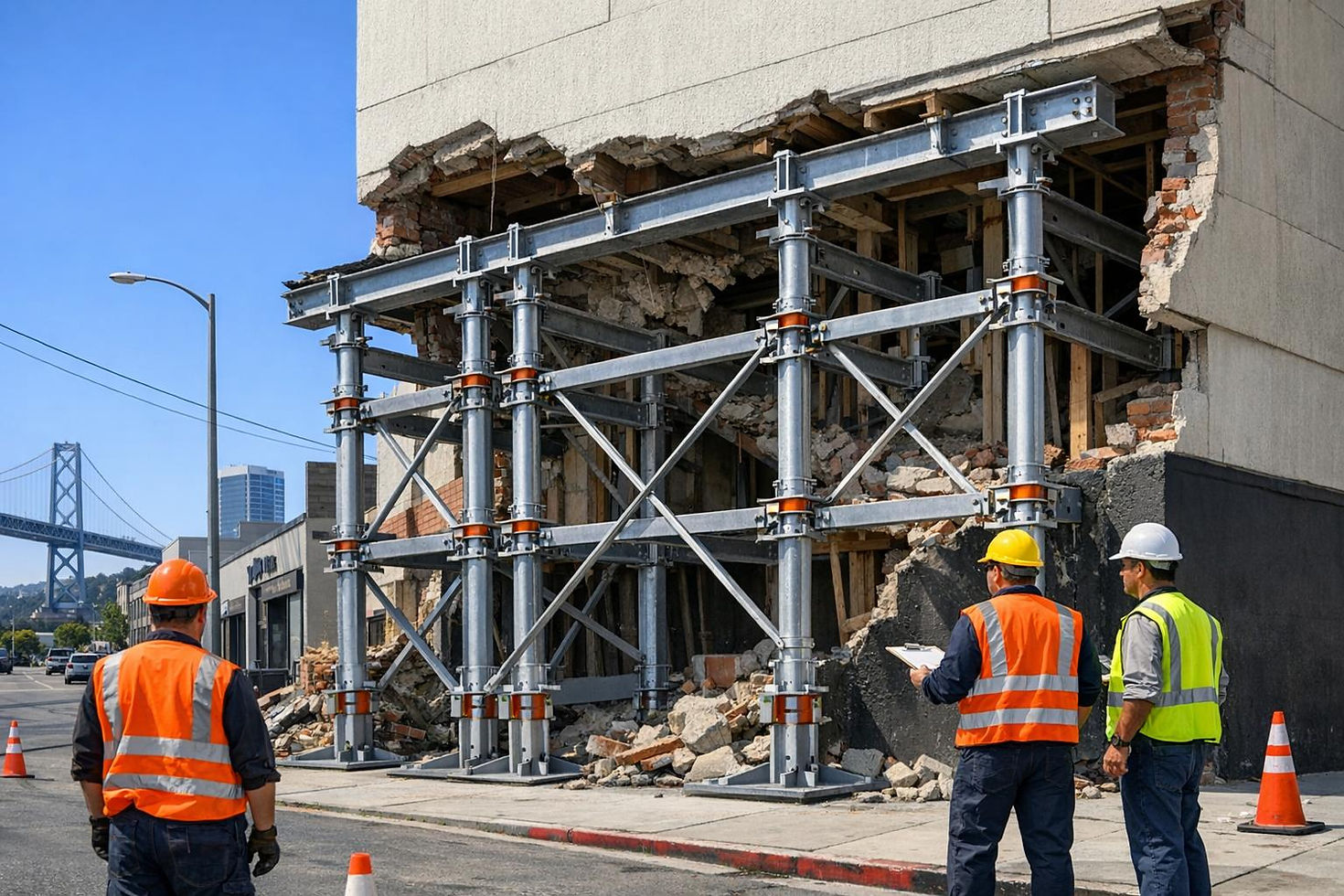
Emergency Structural Shoring Services Across the Bay Area
- Joe Lazzaretti
- Jan 2
- 11 min read

Updated: Jan 3
When earthquakes, floods, or construction accidents threaten buildings, emergency structural shoring stabilizes them to prevent collapse until permanent repairs are made. The Bay Area's high seismic activity (728 earthquakes of magnitude 1.5+ in the past year), soft soils, and aging buildings make this service critical for public safety and property protection.
Key Takeaways:
Seismic Risks: Frequent earthquakes, liquefaction-prone soils, and older buildings increase structural vulnerabilities.
Flooding & Storms: Saturated soils and foundation erosion can destabilize structures, especially in low-lying areas.
Construction Accidents: Deep excavations near transit systems or historic buildings often require immediate stabilization.
Common Shoring Methods:
Soldier Piles & Lagging: Ideal for deep urban excavations.
Sheet Piling: Effective in flood-prone, water-saturated areas.
Hydraulic Shores: Quick, adjustable support for emergencies.
Golden Gate Shoring provides tailored solutions, fast response times, and strict compliance with California safety standards to address the Bay Area's complex needs.
Webinar - Emergency Shoring: Rules of Thumb and Common Mistakes
What Causes Emergency Shoring Needs in the Bay Area
Emergency shoring in the Bay Area often becomes necessary due to seismic activity, flooding or storm damage, and accidents at construction sites. Each of these situations brings unique challenges that require quick action to stabilize structures and safeguard both lives and property.
Earthquakes and Seismic Activity
Located along major fault lines, the Bay Area is no stranger to seismic risks. Earthquakes here can strike suddenly, making rapid responses critical. For example, in the days leading up to January 2, 2026, the region experienced several earthquakes near San Ramon, including a 3.0-magnitude tremor [1][6]. Such events can compromise structures in various ways, with liquefaction being one of the most dangerous.
Liquefaction occurs when saturated soils, especially in areas with man-made landfills or young geologic deposits, lose their strength during an earthquake. This can severely impact structural stability. The USGS Earthquake Hazards Program explains:
"When the ground liquefies, it may lose its ability to support buildings and other structures. Liquefaction during large earthquakes commonly disrupts pipelines and road networks and also may cause buildings to settle and move downslope or toward stream banks." [4]
Older tall buildings are particularly at risk. A 2015 study highlighted seismic vulnerabilities in structures built between 1960 and 1990, including weak lower stories, brittle column splices, and beam-to-column failures [5]. When such buildings are compromised by seismic activity, emergency shoring becomes a crucial step to prevent further damage or collapse.
But earthquakes aren’t the only force that can destabilize structures. Water-related stresses also pose significant risks.
Flooding and Storm Damage
Heavy rain and flooding can wreak havoc on foundations, especially in low-lying parts of the Bay Area. The region’s soft mud deposits, which already amplify shaking during earthquakes, become even more unstable when saturated with water [4]. Properties near the bay margins or built on man-made landfills face heightened risks due to these weak soil conditions combined with their proximity to water sources.
Storms can also expose vulnerabilities in older buildings, particularly those made of unreinforced masonry. When water seeps into foundations or erodes supporting soils, walls may shift or lean dangerously. In these cases, emergency shoring is often deployed to stabilize the structure until permanent repairs can be made.
Construction sites add another layer of complexity to shoring needs.
Construction Site Accidents
Construction projects in the Bay Area frequently involve deep excavations - some as deep as 68 feet - on steep hillsides or in dense urban environments [2]. These high-risk activities, often near critical infrastructure like BART stations, demand meticulous planning and quick action when things go wrong.
Accidents at construction sites are often linked to improper load distribution or unexpected conditions. California regulations require shoring systems to support at least 100 pounds per square foot [7]. However, additional loads - like piles of reinforcing steel or motorized carts, which add another 25 pounds per square foot - can exceed these limits if not properly accounted for [7].
Historic buildings with unreinforced masonry walls are another common concern. These fragile structures often require temporary shoring during nearby construction to prevent collapse [3]. Given that many Bay Area buildings predate modern seismic codes, contractors frequently encounter unforeseen structural issues that necessitate immediate stabilization.
Shoring Techniques and Equipment
In emergencies, contractors need to act quickly to stabilize structures. The Bay Area presents unique challenges, from deep urban excavations to dealing with water-saturated soils. These conditions demand specialized solutions. The choice of shoring technique depends on factors like soil type, excavation depth, and the proximity of nearby structures. Let’s dive into some methods specifically suited to the Bay Area's needs.
Soldier Piles and Lagging Systems
This method involves driving vertical steel H- or I-beams (soldier piles) into the ground, with timber lagging placed between them to hold back soil as excavation progresses [8][9]. It’s a reliable choice for deep excavations, typically ranging from 16 to 40 feet, though some projects in the Bay Area have reached depths of up to 68 feet.
Take the Molecular Foundry project in Berkeley, for example. Tuan and Robinson Structural Engineers designed a 68-foot deep excavation system on a steep hillside at the Ernest Orlando Lawrence Berkeley National Laboratory. They used a combination of soldier piles, tiebacks, and shotcrete to maintain stability [2]. Another example is the 1900 Broadway project in Oakland, where a 30-foot excavation near a BART station required soldier piles with wood lagging and tiebacks to ensure safety [2].
This system is particularly suited to urban settings because pre-drilled soldier piles reduce noise and vibration - key considerations when working near sensitive structures. To ensure stability, contractors typically backfill the space between the excavation face and lagging with sand, which provides tight contact and allows for proper drainage [8].
Sheet Piling for Flood-Prone Areas
When dealing with water-saturated soils, sheet piling is often the go-to solution. This technique uses prefabricated steel sections - commonly U or Z-shaped - that interlock to form a continuous, water-resistant wall. Installation is done with a Vibro hammer, making it ideal for projects near water bodies or in areas with high groundwater levels [9].
The interlocking design effectively prevents water intrusion, but installation can be tricky in hard or rocky soils. For stability, the sheet pile’s toe needs to extend at least 5 feet below the excavation or down to bedrock [8].
Hydraulic Shores
For emergencies, hydraulic shores are a lifesaver. These systems use adjustable cylinders to brace trench walls, offering immediate stabilization with minimal setup time. They’re particularly useful for trench work or situations requiring rapid deployment.
Shoring Method | Best Use Case | Key Advantage | Primary Limitation |
Soldier Piles & Lagging | Deep urban excavations (20–68 ft) | Reduces vibration; urban-friendly | Not water-tight without extra steps [8] |
Sheet Piling | Water-saturated areas | Effective water cutoff | Difficult to install in rocky soils |
Hydraulic Shores | Emergency trench work | Quick to deploy | Limited to shallower depths |
For instance, the 35-foot excavation at Symphony Towers in San Francisco demonstrates how these various methods can work together to ensure safety and structural integrity in the Bay Area’s diverse conditions [2].
Emergency Shoring Projects in the Bay Area
When emergencies strike, precision in engineering becomes non-negotiable. The Bay Area, with its mix of dense urban landscapes and natural hazards, presents unique challenges requiring swift and effective solutions. From deep excavations near vital transit systems to urgent flood responses, these scenarios demand specialized equipment and expertise. Let’s dive into three standout examples that showcase how emergency shoring has been deployed to stabilize critical structures under diverse conditions.
Deep Excavation Stabilization in Oakland
In downtown Oakland, the 1900 Broadway project faced a daunting task: stabilizing an excavation over 30 feet deep, located dangerously close to the 19th Street BART Station. To ensure the station and nearby structures remained secure, Tuan and Robinson Structural Engineers implemented advanced excavation shoring and underpinning systems. The challenge? Keeping transit operations running smoothly while managing such a significant excavation depth[2][10].
Another nearby project at 1100 Broadway brought its own set of obstacles. A 20-foot-deep excavation, positioned just 4 feet from the 12th Street BART line, required a combination of soldier beams, wood lagging, tiebacks, and internal bracing. These measures were critical to protecting transit infrastructure and maintaining operational safety[2][10].
While urban excavations like these are demanding, natural disasters pose an entirely different kind of threat.
Flood and Storm Emergency Responses Near Sacramento
In February 2017, the Oroville Dam emergency became a stark reminder of how unpredictable nature can be. Erosion caused a massive 200-foot-long, 30-foot-deep breach in the spillway of the 770-foot-tall dam - the tallest in the country. Engineers raised alarms that the emergency spillway was at risk of failing within the hour, triggering the evacuation of approximately 188,000 residents. To prevent a catastrophic collapse, eight National Guard helicopters were deployed to drop boulders and rocks into the breach, buying critical time for further stabilization measures[11].
Butte County Sheriff Kory Honea captured the urgency of the situation, saying:
"There is still a lot of unknowns... We need to give the Department of Water Resources time to fully evaluate the situation so we can make the decision to whether or not it is safe to repopulate the area"
This event highlights how rapid and decisive shoring efforts can avert disaster, even in rural or non-urban settings.
Salesforce Tower Excavation in San Francisco
In the heart of San Francisco’s bustling downtown, the Salesforce Tower project - completed in 2017 with a construction value of $1.3 billion - faced extraordinary excavation challenges. Simpson Gumpertz & Heger (SGH) developed a sophisticated multi-stage support system to meet these demands. Their design included Cement Deep Soil Mixing soldier pile retaining walls, a 134-foot diameter secant pile ring, and reinforced jet grout shafts. These measures addressed the site’s complex conditions, including the need to counteract extreme groundwater pressures.
As SGH explained:
"The site's excavation for this project presented significant challenges that our support of excavation design addressed by meeting tight shoring deflection limits [and] mitigating the risk of base heaving due to artesian pressures"
This intricate system not only safeguarded neighboring structures but also ensured stability in one of the city’s most ambitious construction projects.
Golden Gate Shoring's Services and Capabilities
Full Range of Shoring Solutions
Golden Gate Shoring offers a wide array of shoring solutions throughout the Bay Area, including soldier pile systems, sheet piling, and hydraulic shores. Their expertise spans deep foundation engineering, seismic retrofitting, and soil nailing for slope stabilization. For residential projects, they provide house bolting and shearwall bracing in line with FEMA‑approved Plan Set A requirements[15]. When buildings require foundation repairs or the removal of load‑bearing walls, the team uses temporary cribbing and steel beams to ensure structural stability during renovations[16].
Their services also include shotcrete retaining walls and advanced excavation support systems. Whether tackling a 30‑foot‑deep excavation in downtown Oakland or stabilizing vulnerable roadways quickly, the team customizes each solution to address the specific geological and structural demands of the site. This versatility allows them to respond swiftly and effectively to various challenges, including emergencies.
Fast Deployment and Emergency Response
Golden Gate Shoring is well-prepared for emergencies, leveraging their technical expertise to act quickly when needed. Their principals and staff actively participate in the Structural Engineers Association of Northern California's Disaster Emergency Services Committee, ensuring they are ready to respond to seismic or construction-related emergencies[3]. Additionally, their engineers have completed ATC‑20 Post‑Earthquake Safety Evaluation training, enabling them to serve as volunteer disaster service personnel immediately after an earthquake.
Licensed Structural Engineers (SE) and Civil Engineers (PE) conduct on-site assessments within hours, not days. For trench work, their hydraulic shoring systems provide quick installation and removal while offering adjustable support - essential when public safety is at risk due to utility collapses or sinkholes[13][14].
Safety Standards and Code Compliance
Golden Gate Shoring prioritizes safety by adhering to California's strict regulatory standards. All shoring systems meet the requirements of California Title 8, Section 1717, which governs falsework and vertical shoring installations. For systems exceeding 14 feet in height or 16 feet in span, detailed design calculations must be approved by a California‑registered civil engineer[7]. Before any concrete is poured or materials are loaded, a registered engineer inspects the system and provides written certification verifying compliance with approved plans[7].
To enhance safety, the team keeps shoring layouts on-site at all times and installs perimeter guardrails immediately after setting up the supporting members. Each system is designed to handle a minimum total load of 100 pounds per square foot and a lateral load resistance of at least 100 pounds per lineal foot[7].
Conclusion
The Bay Area's frequent seismic activity, dense urban layout, and critical infrastructure make emergency structural shoring a necessity for safeguarding both lives and property. From deep urban excavations to historic buildings in need of urgent stabilization, the region demands quick, reliable solutions tailored to its unique challenges.
Golden Gate Shoring rises to meet these demands with solutions that are not only compliant with local codes but also specifically designed for the Bay Area's complexities. Their team of engineers, deeply involved in local professional organizations, is always prepared to tackle emergencies with speed and precision. Whether it's stabilizing excavations near vital transit systems or protecting historic landmarks during renovations, their expertise ensures that the region's infrastructure remains secure.
In a place where critical systems operate at full capacity, proper shoring is key to avoiding long-term disruptions. The Bay Area's strict safety codes and complex soil conditions require an approach rooted in a thorough understanding of local geology, seismic risks, and the constraints of urban development.
For engineers, contractors, and property owners facing urgent stabilization challenges, access to fast-deploying and expertly crafted shoring systems can make all the difference. With their blend of technical skill, regulatory knowledge, and rapid response, Golden Gate Shoring helps keep structures safe during the region's most demanding situations.
FAQs
What are the main reasons for structural instability in the Bay Area?
Structural instability in the Bay Area stems from three main factors:
Seismic activity: Nestled in an earthquake-prone region, the Bay Area has faced its share of tremors, with the 1989 Loma Prieta earthquake (magnitude 7.1) serving as a stark reminder of the damage ground motion can inflict. Older structures, built before modern seismic standards, are particularly at risk. Even smaller quakes can gradually weaken these buildings over time.
Aging infrastructure: Many of the area’s buildings and bridges have been standing for decades without updates to withstand seismic forces or other potential hazards. This aging infrastructure is more susceptible to damage from earthquakes, landslides, or even fires.
Construction and urban growth: Rapid development in the Bay Area often involves excavation, foundation work, or alterations to existing structures. Without proper precautions, such activities can compromise the stability of walls, columns, or nearby buildings, especially in densely populated areas like downtown Oakland.
These challenges underscore the need for proactive solutions, such as retrofitting and emergency shoring, to maintain safety and structural integrity across the region.
How do shoring methods address challenges like earthquakes and flooding?
Shoring techniques are selected with care to address the unique challenges posed by natural events such as earthquakes and flooding, ensuring structures remain secure and stable.
For earthquakes, shoring systems are designed to absorb and redistribute seismic forces. Methods like base isolation, lateral bracing, and reinforced connections allow buildings to move with the ground during tremors, reducing the risk of significant damage. These techniques play a crucial role in protecting the integrity of critical structural elements and preventing collapse during seismic events.
When it comes to flooding, shoring focuses on managing hydrostatic pressure and preventing water intrusion. Solutions such as sheet-pile walls, braced trench systems, and raking shores help stabilize structures by resisting lateral water pressure and forming watertight barriers. These approaches are particularly useful for excavations or buildings exposed to sustained water contact.
By adapting shoring methods to the specific natural hazard, engineers can effectively stabilize structures, safeguard occupants, and meet local building code requirements.
How does Golden Gate Shoring ensure safety and compliance during emergency structural shoring projects?
Golden Gate Shoring places a strong emphasis on safety and compliance, ensuring every aspect of their work aligns with California's rigorous licensing, bonding, and insurance standards. Their team consists of highly skilled professionals who undergo regular OSHA-level safety training. They rely on engineered shoring systems, meticulously designed and inspected by their in-house engineers, to guarantee proper load distribution. This precision helps prevent structural failures and safeguards everyone on-site.
When emergencies arise, Golden Gate Shoring acts swiftly with a structured assessment process led by experienced structural specialists. They evaluate the situation, develop a tailored shoring plan, secure all necessary permits, and oversee the plan's implementation with close supervision. Each project is meticulously checked against local building codes and national safety guidelines to ensure full compliance. Throughout the job, they conduct regular inspections, perform load testing, and make adjustments as needed to uphold safety and engineering accuracy.


Comments