
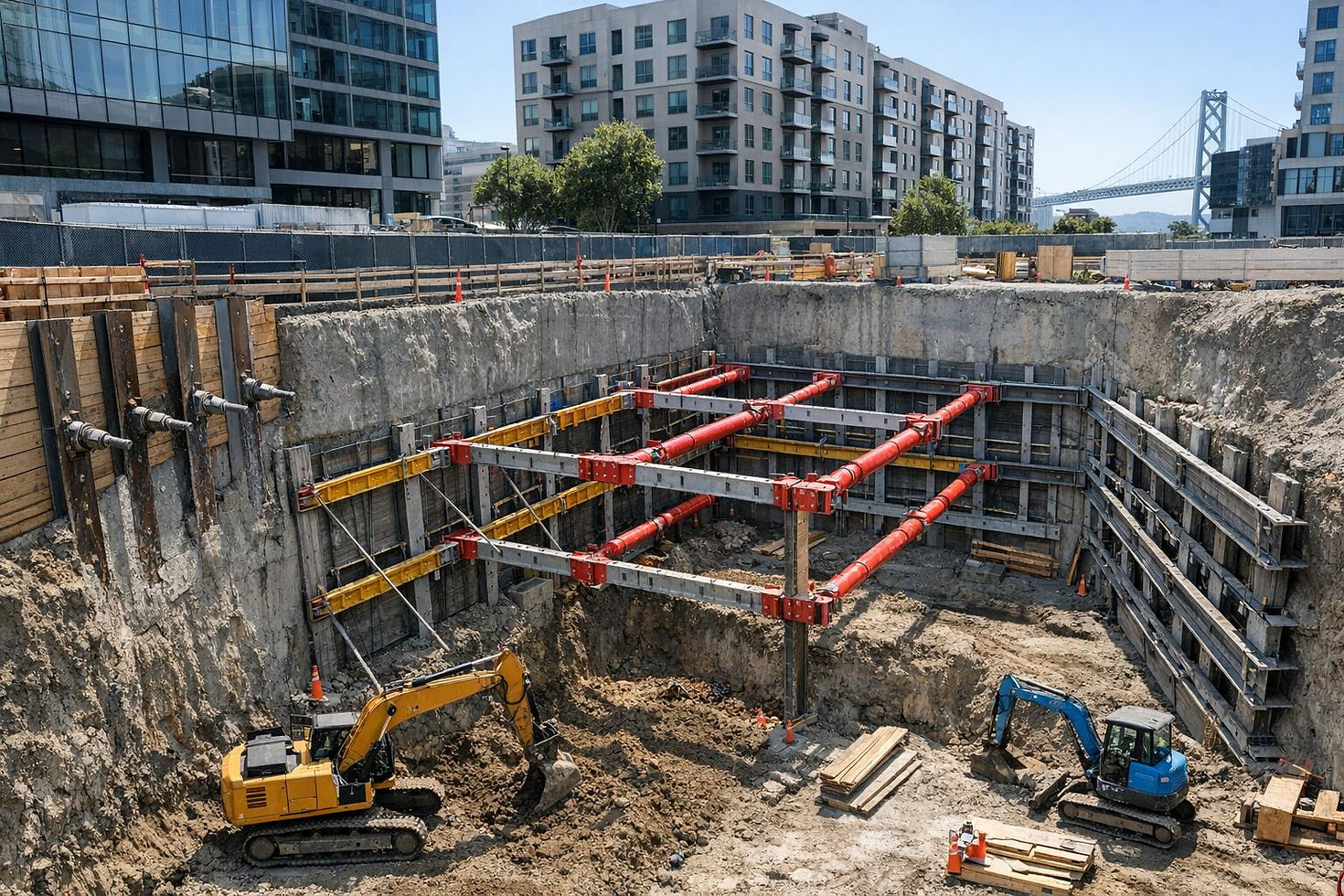
Types of Structural Shoring Used in Bay Area Construction
- Joe Lazzaretti
- Jan 2
- 11 min read

Updated: Jan 2
The Bay Area's unique challenges - frequent seismic activity, variable soil conditions, and tight urban spaces - make structural shoring essential for safe construction. Shoring provides temporary support during excavation or construction to prevent collapses and ensure stability. Here's a quick breakdown of key points:
Seismic Activity: Over 700 earthquakes (magnitude 1.5+) occurred in the past year. Shoring systems must handle both vertical and lateral forces.
Soil Variability: Sites often have a mix of bedrock and loose, liquefiable soils, increasing risks like lateral spreading.
Urban Constraints: Limited space and proximity to existing structures require precise, engineered solutions.
Common Shoring Methods:
Hydraulic Shoring: Quick to install; ideal for small, shallow projects.
Beam and Plate Shoring: Handles deeper excavations with heavy loads.
Soldier Pile Shoring: Effective for deep, narrow sites; allows drainage.
Secant Pile Shoring: Creates watertight barriers for deep, waterlogged areas.
Soil Nail Shoring: Stabilizes steep slopes or hillsides.
Each method is tailored to specific project needs, ensuring safety and compliance with California regulations. Whether dealing with seismic forces, soil challenges, or urban constraints, proper planning and engineering reviews are critical for success.
What Is Shoring In Construction? - Civil Engineering Explained
Bay Area Construction Challenges
The Bay Area is a region where geological quirks meet urban density, creating a tough environment for construction. Here, structural shoring isn’t just a precaution - it’s a necessity. The unique challenges of the area demand shoring systems that go above and beyond what’s required in many other parts of the country.
Seismic Activity and Earthquake Preparedness
The Bay Area is no stranger to ground movement. From January 2, 2025, to January 2, 2026, the region experienced 728 earthquakes of magnitude 1.5 or greater - an average of about two quakes per day. In the 30 days leading up to January 2, 2026, there were 177 recorded events [2].
This constant seismic activity means shoring systems here must do more than handle vertical loads; they also need to withstand lateral forces caused by ground shifts. California regulations require shoring systems to resist lateral loads of at least 100 pounds per lineal foot of floor edge or 2% of the total dead load, whichever is greater [1]. And that’s just the beginning - soil conditions in the area add another layer of complexity.
Soil Variability and Liquefaction Risks
The Bay Area’s underground landscape is a patchwork of challenges. Back in the late 1800s, developers filled in sand dunes, marshes, and mudflats using rubble and debris from demolished buildings [5]. The result? Construction sites today often face wildly differing soil conditions, even within the same lot.
Take San Francisco’s South of Market (SOMA) district, for example. On one side of a site, you might find solid bedrock, while the other side could have up to 60 feet of compressible deposits and liquefiable fill [5]. During an earthquake, these loose, water-saturated soils can liquefy, leading to lateral spreading that threatens the stability of pile foundations and shoring systems [4].
"The term 'lateral spreading' in this document refers to global movements of soil due to liquefaction of underlying cohesionless soil and hence includes cases that might be described as flow liquefaction (e.g., slope instability)." - Scott A. Ashford, Ross W. Boulanger, and Scott J. Brandenberg, PEER Report 2011-04 [4]
A real-world example of this challenge occurred in January 2017 at the 270 Brannan project in San Francisco. The site, located on a historic shoreline, featured bedrock on one side and 60 feet of liquefiable fill on the other. To address these conditions, the team employed cement Deep Soil Mixing (DSM) panels alongside micropiles. This combination helped counteract the risks of lateral spreading and liquefaction while ensuring the stability of the foundation and shoring system [5].
Urban Construction Constraints
On top of the geological hurdles, urban construction in the Bay Area comes with its own set of problems. Space is tight, and traditional excavation methods that require wide footprints simply don’t work in densely built areas [6]. Instead, contractors have to use vertical shoring systems that can support excavation walls without encroaching on neighboring properties.
And then there’s the issue of working near existing structures. Shoring systems not only have to support the excavation but also prevent settlement or damage to nearby buildings [6]. In cases where construction sites intersect with vehicular or rail traffic, California law requires detailed design calculations to be reviewed and approved by a registered civil engineer [1]. Additionally, vertical supports must sit on properly compacted bases with sufficient load-bearing capacity - a task made harder by shifting soil conditions and weather-related challenges [1].
Types of Structural Shoring Used in Bay Area Construction
In the Bay Area, ensuring excavation safety and stability is a top priority. Contractors have a range of shoring techniques at their disposal, each tailored to specific project needs - whether it’s a tight urban site or a location dealing with groundwater issues. Below is an overview of the most commonly used systems, designed to address the region’s unique seismic and soil challenges.
Hydraulic Shoring
Hydraulic shoring is a go-to solution for smaller excavations that need quick and efficient support. This system uses aluminum hydraulic cylinders as crossbraces, combined with vertical rails (uprights) or horizontal rails (walers) to stabilize excavation walls and prevent collapses [6].
"Aluminum hydraulic shoring. A pre-engineered shoring system comprised of aluminum hydraulic cylinders (crossbraces) used in conjunction with vertical rails (uprights) or horizontal rails (walers). Such system is designed specifically to support the sidewalls of an excavation and prevent cave-ins." - California Department of Industrial Relations [6]
The hydraulic pressure applied by this system provides lateral support to unstable soil, making it a reliable choice for utility repairs or foundation work. It’s especially effective in mitigating soil pressures during seismic activity. However, its application is limited to smaller projects and isn’t suitable for deep or large-scale commercial excavations.
Beam and Plate Shoring
For deeper excavations that require heavy-duty support, beam and plate shoring is an excellent choice. This system uses steel beams and plates to handle significant loads, making it ideal for multi-level basements or underground parking structures. California regulations mandate that these systems support at least 100 pounds per square foot for combined live and dead loads, with an additional 25 pounds per square foot when motorized equipment is used [1].
Any shoring system exceeding 14 feet in height or a 16-foot horizontal span must be reviewed and approved by a California-registered civil engineer [1]. This ensures the system can withstand not just vertical loads but also the lateral forces caused by seismic activity, a critical consideration in the Bay Area.
Soldier Pile Shoring (H and I-Beam)
Soldier pile shoring is a dependable option for deep, narrow excavations, especially in crowded urban areas. This method involves driving H or I-beams vertically into the ground and placing horizontal lagging - wood or concrete planks - between the beams to hold back soil. To ensure stability, the bottom of each pile must extend at least 5 feet below the excavation or reach bedrock [7].
One of its key advantages is its ability to handle drainage. The gaps between lagging allow water to pass through, while materials like hay can be used to retain soil without blocking drainage [7]. A notable example is the BART Shattuck Avenue excavation in Berkeley, where soldier piles and horizontal H-beam struts supported street traffic while construction continued below [8]. Similarly, at San Francisco’s Embarcadero Center, external H-piles were driven through a slurry wall to reduce internal congestion [8]. This flexibility makes it a popular choice for projects in urban settings.
Secant Pile Shoring
Secant pile shoring is a sophisticated technique that creates a seamless, watertight barrier by drilling overlapping concrete piles. These piles alternate between primary (un-reinforced) and secondary (reinforced) piles, forming a robust wall that excels in both lateral support and water exclusion.
While this method is more complex and expensive, it’s unmatched when it comes to dealing with groundwater. Unlike soldier piles, which are typically used for depths up to 16 feet (or engineered up to 40 feet), secant piles can handle much deeper excavations while maintaining structural integrity [9]. This makes them a top choice for urban sites with deep basements or nearby structures that require extra protection.
Soil Nail Shoring
For stabilizing steep slopes or hillside excavations, soil nail shoring is a practical and economical choice. This technique involves drilling into the excavation face, inserting reinforcing bars (nails), grouting them in place, and applying shotcrete to create a stable wall. The nails work in tension to strengthen the soil, turning it into a cohesive mass that resists movement.
Soil nailing is particularly effective in tight urban spaces where other excavation methods may not be feasible. However, it’s not suitable for very loose or water-saturated soils, as the method relies on stable soil conditions for proper bonding. A thorough geotechnical analysis is essential to determine its viability for a given site.
Comparison of Shoring Techniques
Choosing the right shoring system in the Bay Area means weighing factors like depth capacity, seismic resilience, soil conditions, installation speed, and cost. Here's a closer look at how different techniques stack up:
Hydraulic shoring is known for its quick installation. Using adjustable hydraulic pistons to press metal plates against trench walls, it’s perfect for shallow excavations and trenching jobs [11].
On the other hand, soldier pile systems shine when it comes to depth capacity - handling projects as deep as 68 feet, such as at the Molecular Foundry [12][11]. If you're dealing with waterlogged conditions, secant pile shoring is a strong contender. It performs well in areas with high water tables, though it tends to come with a higher price tag [11]. A bonus for soldier pile systems? Their steel beams are reusable, which can help cut costs for deep urban projects [12][11].
For hillside work, soil nail shoring is a go-to solution for steep slopes. A standout example is the 50-foot high permanent soil nail wall at the Sunol Valley Water Treatment Plant, which ensures long-term stability [12].
Comparison Table of Shoring Types
Shoring Type | Depth Suitability | Seismic Performance | Installation Speed | Soil Compatibility | Bay Area Project Example |
Hydraulic | Shallow (Trenches) | Moderate | Very Fast | Stable trench walls | General utility repairs |
Beam and Plate | Deep | High (with proper engineering) | Moderate | General urban soil | Multi-level basements |
Soldier Pile | Very Deep (20-68+ ft) | High (with internal bracing) | Moderate | Dense urban soil, Dune Sand | 1100 Broadway, Oakland; Molecular Foundry, Berkeley [12] |
Secant Pile | Very Deep | Excellent (watertight/rigid) | Slow | Waterlogged, high water table | 555 Mission Street, SF [12] |
Soil Nail | Up to 50 ft (permanent) | High (permanent stability) | Moderate | Steep hillsides, stable soil | Sunol Water Treatment Plant [12] |
This breakdown underscores the importance of matching the shoring technique to the project’s specific needs.
In the Bay Area, where soil conditions can vary drastically over just 50 feet and seismic bracing is critical - especially near historic sites - site-specific studies are crucial [10].
"Shoring has to work during normal digging AND during an earthquake. That's a pretty big ask." - West Coast Drilling Co. [10]
These considerations don’t just affect the engineering; they also play a big role in determining overall timelines and costs, making careful planning essential for success.
Selecting the Right Shoring System for Bay Area Projects
Choosing the right shoring system starts with aligning it to the specific demands of your project. For shoring heights exceeding 14 feet or spans over 16 feet, an engineering review is required by regulation [1]. For smaller projects, manufacturer or contractor approvals can often suffice, which helps reduce engineering fees. These requirements ensure the shoring system is tailored to the unique challenges of each site.
Given the Bay Area's seismic activity and variable soil conditions, it's crucial to provide stable vertical supports. These supports should rest on compacted, level bases designed to handle the soil's load-bearing capacity [1]. Environmental factors, like weather or concrete pouring, can weaken soil strength, so it’s important to factor these into your planning. In areas near historic shorelines, such as San Francisco's SOMA district, Deep Soil Mixing (DSM) panels are a practical solution. They not only create a stable foundation but also help reduce liquefaction risks [5].
Budget and system design must work hand-in-hand while adhering to California's minimum design load standards [1]. Lateral load resistance is equally important: shoring systems must handle at least 100 pounds per lineal foot of floor edge or 2% of the total dead load, whichever is greater [1]. If motorized carts will be used on the shoring, add 25 pounds per square foot to your load calculations. For worker-propelled carts, include an additional 10 pounds per square foot [1].
Smart planning can save costs without compromising safety. Pre-engineered systems, like aluminum hydraulic shoring with tabulated data, are often more cost-effective than custom timber solutions [6]. For deeper excavations in earthquake-prone areas, pile foundations remain a reliable choice to manage lateral ground movement [4]. Additionally, incorporating micropiles with DSM can counteract seismic forces like overturning and uplift [5].
Equally important is maintaining thorough documentation. A detailed shoring layout or falsework plan should always be accessible on-site [1]. For systems exceeding the 14-foot or 16-foot thresholds, a registered civil engineer must inspect the setup and certify in writing that it meets the working drawings before concrete placement begins [1]. This documentation underscores the high safety and performance standards required for Bay Area construction projects.
Conclusion
Structural shoring plays a key role in ensuring construction safety in the Bay Area, a region known for its seismic activity and unpredictable soil conditions. These unique challenges demand resilient shoring systems tailored to specific needs. Whether it’s hydraulic shoring for quick stabilization or secant pile systems for deeper, more complex excavations, each method is designed to address distinct site requirements.
However, choosing the right shoring system goes beyond just matching techniques to terrain. California regulations require that projects exceeding 14 feet in height or 16 feet in width secure approval from a registered civil engineer to guarantee worker safety and structural soundness [1][3]. Additionally, all systems must comply with local load standards to meet regulatory demands.
Factors like soil conditions, seismic risks, and space constraints heavily influence the choice of shoring. In the Bay Area, where these variables are particularly pronounced, careful planning and adherence to safety protocols are critical. By combining engineering knowledge with thoughtful preparation, construction teams can tackle the region's challenges effectively, ensuring projects stay safe, compliant, and on schedule.
FAQs
How does earthquake risk impact the choice of shoring systems in Bay Area construction?
In the Bay Area, where seismic activity is a constant concern, choosing the right shoring system for construction projects is crucial. Temporary shoring systems must be built not only to handle lateral earth pressures but also to endure the dynamic forces triggered by ground movements during an earthquake.
Engineers often lean toward restrained systems - such as braced or anchored walls - because they offer enhanced stability. These systems use tension or compression components like braces, rakers, or anchors to withstand seismic forces effectively.
On the other hand, unrestrained systems, like cantilevered walls, depend solely on passive soil resistance. While these systems are simpler, they are generally limited to a height of about 18 feet and offer less robust seismic performance.
To adhere to California’s stringent seismic design standards, all shoring systems must meet the requirements outlined in the California Building Code. This includes integrating safety features like tie-backs and anchorage specifically designed to handle earthquake stresses. Such measures are essential to safeguard workers, protect nearby structures, and keep construction schedules on track during seismic events.
What makes secant pile shoring a good choice for waterlogged construction sites?
Secant pile shoring works exceptionally well in waterlogged areas because the overlapping concrete piles form a nearly watertight barrier. This design helps prevent groundwater from seeping into the excavation, minimizing the need for extensive dewatering and keeping the site dry and stable.
Beyond this, secant piles offer excellent lateral support, making them capable of withstanding both soil and water pressure. This feature is especially valuable for deep excavations where significant hydrostatic pressure is a concern. When installed correctly, the piles create a tight seal, boosting stability and safeguarding the structural integrity of projects in saturated soil conditions.
Why is an engineering review required for shoring systems taller than 14 feet?
An engineering review is crucial for shoring systems taller than 14 feet because these structures encounter much greater loads, stability issues, and safety concerns. In California, regulations outlined in Title 8, § 1717 mandate that such systems include detailed design calculations and drawings, which must be approved and signed by a licensed civil engineer. This process ensures the system is capable of withstanding vertical and lateral forces, incorporates sufficient bracing, and complies with state safety requirements.
Skipping this step significantly raises the risk of structural failures, worker injuries, and expensive delays - risks that are amplified in the Bay Area due to seismic activity and wind loads. Professional engineering oversight is key to achieving safe and efficient construction, even on the most demanding sites.


Comments